EU Biofuel Scenarios Warn of Rising Emissions and Land Pressure After 2030
A modelling analysis finds that expanded crop-based biofuels could increase transport emissions, land use and pressure on food supplies.

Choices about crop-based biofuels after 2030 could affect transport emissions and land use across the EU for decades. A modelling analysis by Transport & Environment (T&E) finds that the current Renewable Energy Directive framework could allow food- and feed-crop biofuel use to rise well above 2024 levels, with larger increases under more permissive limits.

The central tension is that biofuels can replace some petroleum in transport, but fuel made from crops also draws on farmland and supply chains that serve food and animal feed. The climate outcome depends on more than what comes out of an exhaust pipe: when the land needed to grow fuel crops is included, the emissions balance can be worse than the fossil fuel being displaced.
Three possible paths for crop-based fuels
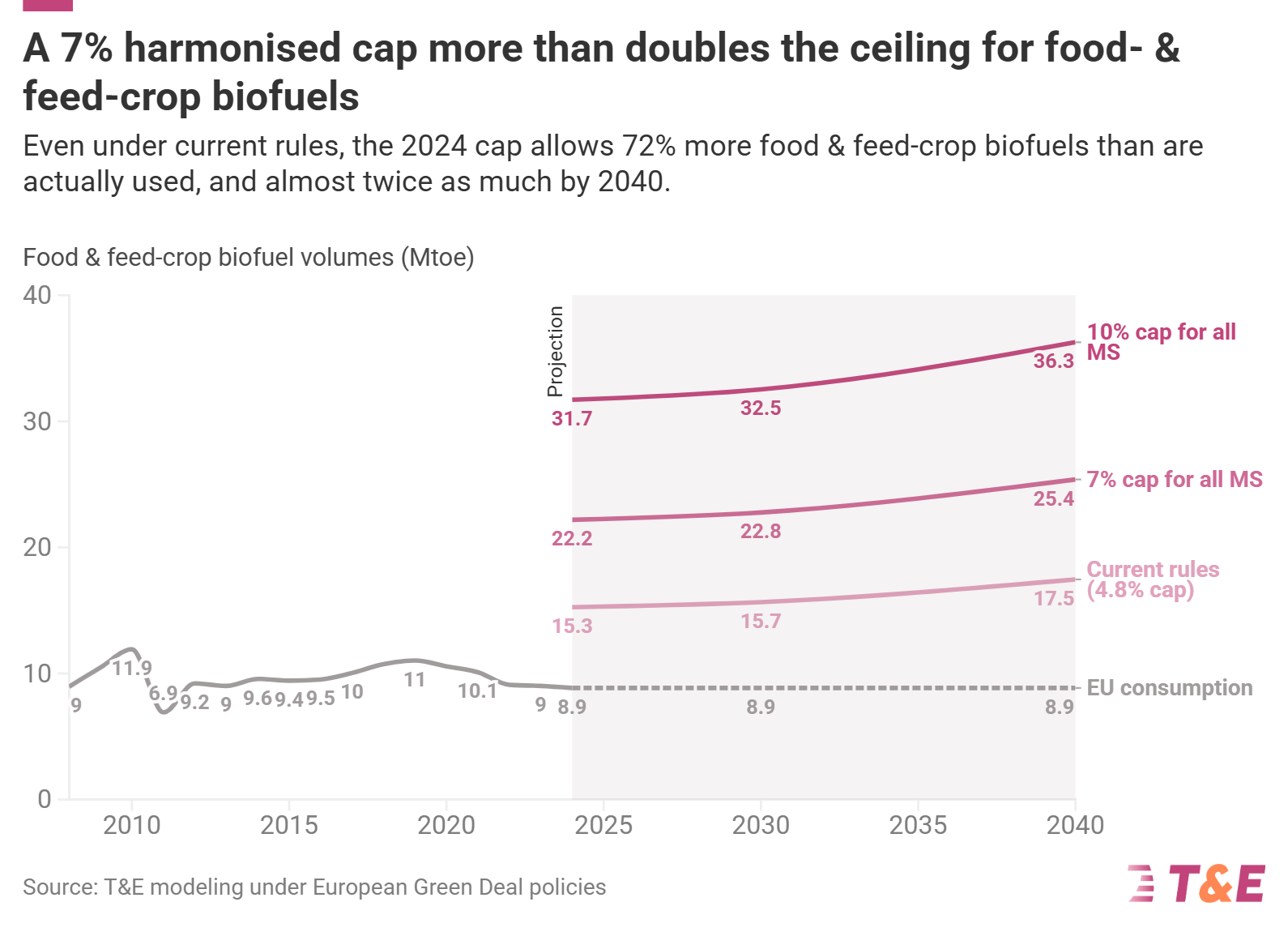
The analysis compares three scenarios for the period to 2040. Under the current RED III cap, use of first-generation biofuels made from food and feed crops could reach a level 72% above the amount consumed in 2024. This is a potential increase allowed by the framework, rather than a prediction that the extra fuel will necessarily be used.
The emissions already associated with these fuels are significant in the analysis. At current consumption, first-generation biofuels account for nearly 43 million tonnes of carbon dioxide equivalent (MtCO2e) when indirect land-use change is included. T&E estimates this to be about 23% more than the emissions from the fossil fuels they replace.
Indirect land-use change captures a knock-on effect: if land or crops are diverted to fuel production, food and feed production may shift elsewhere, potentially creating pressure to convert other land. The calculation therefore looks beyond the immediate field or fuel plant. The source material does not provide the modelling assumptions behind each scenario, so the figures are best read as outcomes under specified limits, not as precise forecasts.
With safeguards similar to those in RED III and other transport rules, the analysis finds that crop-based fuel volumes, land area and emissions could each double by 2040. T&E compares the resulting emissions with those of more than five million diesel cars. That comparison conveys scale; it does not mean the fuels would be used in cars alone or that the impacts would occur in one place.

Higher limits bring larger land demands
A scenario that sets a common 7% cap across Member States’ transport sectors produces a steeper increase. In that case, volumes, land use and emissions could approach three times today’s levels. The most expansive scenario examined raises the cap to 10%. It would bring each measure to around four times current levels by 2040.
Under the 10% scenario, land devoted to biofuel crops could reach 17.7 million hectares, or 18% of the EU’s arable land. The analysis describes this area as larger than Greece. Associated emissions would exceed those from the fossil fuels replaced by 33 MtCO2e.
These figures point to a practical trade-off for transport decarbonisation: a higher volume of renewable fuel does not automatically mean a lower climate impact. The result depends on the feedstock, how it is produced, what land it uses and what activity it displaces. Crop-based fuels also compete for agricultural resources, so expanding their use can put pressure on food and feed supply chains even when the fuel is counted as renewable.
Scarce waste and advanced feedstocks
The analysis also raises concerns about advanced and waste-based biofuels. These feedstocks are limited, and T&E argues that the road sector is using more than its available share. The briefing points instead to sectors that are harder to electrify, particularly aviation, as potential users of those constrained supplies.
That allocation question matters because different transport modes have different routes to reducing emissions. Where direct electrification is practical, using scarce biofuel feedstocks in road transport may leave less available for activities with fewer alternatives. The source does not quantify how much fuel each sector would need, so it supports a direction for prioritisation rather than a precise allocation target.
Supply-chain oversight is another concern. T&E cites recent fraud cases as evidence of risks when relying on exports from outside the EU. It argues that palm oil derivatives should be phased out and that safeguards should distinguish the most sustainable feedstocks. The analysis does not detail the cases or quantify their emissions, but it underscores that a fuel’s claimed origin and sustainability need to be verifiable.
The figures make the design of the post-2030 framework consequential: limits on crop-based fuels, careful accounting for land-use effects, and credible checks on feedstock supply will shape whether renewable fuel use delivers emissions cuts while managing pressure on farmland. The full T&E briefing provides the modelling scenarios.