Europe’s Battery Makers Face a Demand and Supply Chain Squeeze
A proposed car industry deal could leave most planned European battery output without demand, while weaker emissions targets add pressure.

Europe’s planned battery factories face a two-sided challenge: the Franco-German car deal would secure demand for only a small share of their expected output, while weaker vehicle emissions targets could shrink the market for batteries further. Together, the changes could make it harder for cell and component makers to build a stable European supply chain.
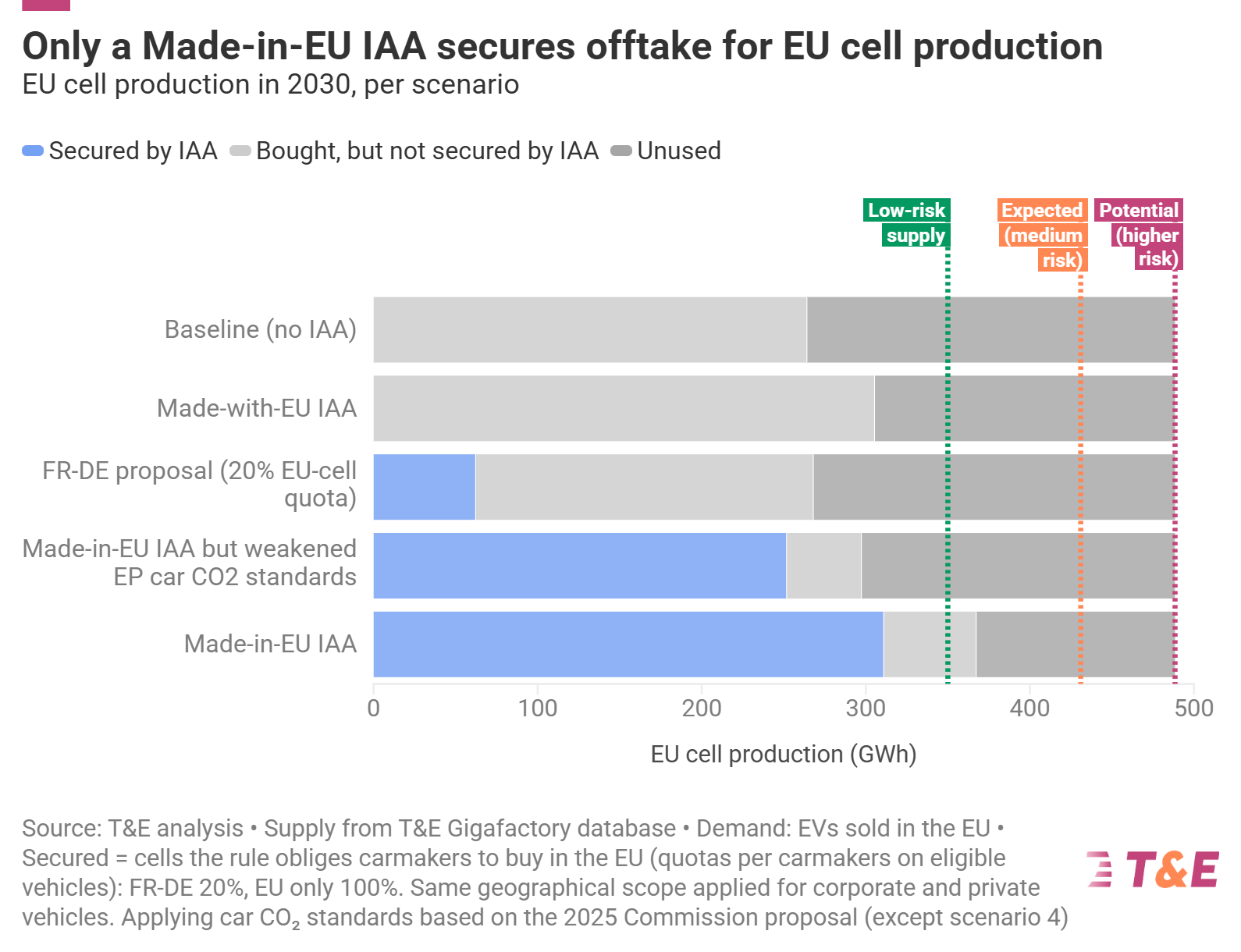
An analysis by Transport & Environment (T&E) estimates that the deal would secure just 13% of planned European battery cell production in 2030. The calculation points to a gap between the capacity companies are preparing to bring online and the demand that would be directed toward locally made cells. That gap matters because factories need sustained orders to ramp up production and spread their costs across more units.
The Industrial Accelerator Act (IAA) proposal includes local content requirements intended to connect subsidies and tax incentives with manufacturing in Europe. T&E estimates that weak requirements could leave 100 gigawatt-hours (GWh) of cell demand and 250 GWh of cathode active material demand open to supply from elsewhere in 2030. The cell volume is equivalent to about 1.5 million battery packs.
Local production is already supplying a large share
The proposed deal would require European-made cells in 10% of eligible vehicles in 2028 and 2029, 20% in 2030 and 2031, then 70% from 2032. T&E says more than half of the cells in electric vehicles sold in the European Union are already made in Europe. Its comparison suggests the proposed thresholds could secure less demand than the market currently provides.

For 2030, the deal would support cell production equivalent to around 900,000 electric vehicles, according to the analysis. Under a stricter Made-in-EU approach within the IAA, the equivalent would be 4.6 million vehicles. The contrast is significant for companies planning factories years ahead: a factory’s expected capacity has little commercial value if buyers can meet their needs without purchasing its output.
The scope of eligible suppliers also affects where that demand lands. If a broad range of free-trade partners qualifies, lower-cost producers outside Europe could supply a larger share of cells and cathode materials. T&E estimates that this could shift about 100 GWh of cell demand and 250 GWh of cathode active material demand away from European production in 2030.
Components need dependable orders too
Cell factories are only one part of the supply chain. Cathode active material is a key battery component, and producers need large, predictable contracts with cell makers and vehicle manufacturers before they can scale. A local content approach that supports cells but leaves component demand uncertain may therefore fail to establish a durable regional supply chain.
T&E’s analysis finds that a strict European scope could make the proposed cathode material requirements achievable by 2030, with only limited supply from trusted partners. From 2032, production within the European Union alone could cover expected demand under the IAA approach. The analysis estimates that the act would add 323 GWh of demand, raising total European-made cathode active material to 407 GWh and securing 94% of expected European supply.
Those projections depend on factories reaching production and on demand developing as expected. Many of the cell plants counted in Europe’s 2030 capacity plans have not yet started operating. The analysis names Lyten, formerly Northvolt, in Sweden; PowerCo Salzgitter in Germany; and Verkor Dunkirk in France as projects whose prospects could be affected by weaker demand incentives.
Vehicle targets shape battery demand
Changes to vehicle emissions targets would add a separate pressure on the sector. T&E estimates that proposals to weaken those targets could reduce cell demand by 247 GWh between 2027 and 2032, equivalent to batteries for about 3.7 million electric vehicles made in the European Union. The analysis compares that reduction with nearly three times the annual capacity of LG Energy Solution’s plant in Poland, which it identifies as Europe’s largest battery factory.
The two effects work through different parts of the market. Local content rules influence where automakers source cells and materials; emissions targets influence how many electric vehicles they need to sell and, in turn, how many batteries the market requires. If both local sourcing incentives and vehicle demand weaken, new factories may struggle to secure the contracts needed to reach planned output.
For battery makers and their customers, the next test is whether the final design of the IAA provides a clear, dependable route from factory investment to orders. The figures suggest that Europe has substantial planned capacity, but keeping it viable will depend on both a strong electric vehicle market and supply rules that give local cell and component producers enough demand to scale.