CETO Wave Energy Unit Completes First Offshore Deployment at BiMEP
Carnegie’s CETO actuator reached its mooring at Spain’s BiMEP site, preparing the team for a later grid-connected deployment after further onshore tests.
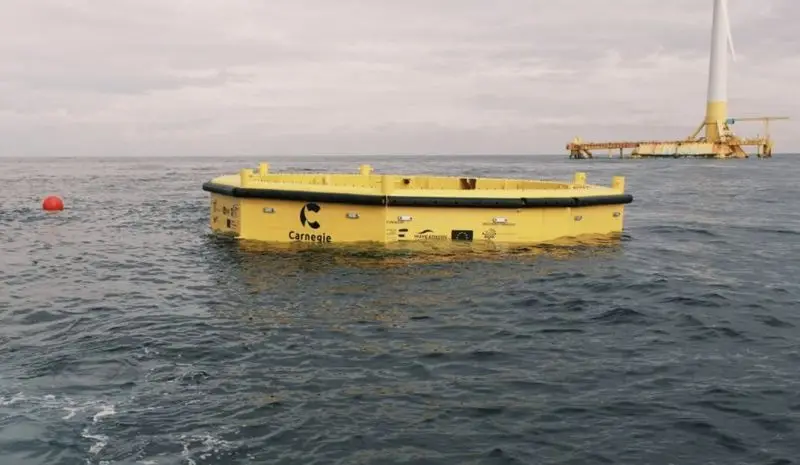

Carnegie Clean Energy has taken an important operational step toward testing its CETO wave energy technology at sea: the system’s buoyant actuator has been installed at the Biscay Marine Energy Platform (BiMEP) in Spain’s Basque Country. The unit is the system’s prime mover, and this first offshore phase is designed to build experience with the practical work needed before a complete, grid-connected CETO system is deployed.
The brief installation is part of the ACHIEVE Programme. Its immediate purpose is to test the sequence of getting equipment from local fabrication through port assembly and towing to an offshore berth, including the maritime authorization steps and local supply chain logistics. Those details can shape the cost, schedule and repeatability of later deployments, even before a device begins delivering electricity.
From Basque workshop to offshore berth
The actuator’s three modular sections were transported from a fabricator in the Basque region to the Port of Bilbao. There, the sections were assembled on the quay. A crane then lowered the completed unit into the water, where it was held alongside the quay in preparation for towing.
On November 14, the actuator was towed from Bilbao to Carnegie’s pre-permitted berth at BiMEP. At the site, it was connected to a specially installed mooring and anchor system. This sequence gives the team a chance to work through important marine operations with the actuator itself: moving a modular structure through a working port, launching it, towing it offshore and securing it at its test location.
That work is a useful early check on deployment procedures, but it does not establish how much power the complete system can produce or how it will perform when connected to the grid. The actuator is expected to remain at the offshore site only for a short period, then be retrieved and returned to port when the current weather window ends. The deployment therefore offers operational experience rather than a sustained test of electricity generation.
Onshore testing before the next offshore phase
Over the winter, the actuator is due to be kept onshore while the power take-off (PTO) modules undergo final local testing. The PTO components are central to converting the motion captured by the wave energy device into usable power. Carnegie says the tests will pair the PTO modules with an electrical module and simulate real ocean conditions, checking mechanical and electrical operation as well as control and communications functions.
That work is intended to build confidence in how the equipment behaves as an integrated system before the next offshore step. Testing components onshore gives the team a controlled setting to check their interactions and address issues ahead of installation. The first deployment’s learnings on assembly, towing and mooring can then inform the planning for a more complete system at BiMEP.
Carnegie’s stated target is a full CETO deployment with a grid connection in European spring 2027. The gap between the short actuator installation and that planned milestone matters: the project is proceeding in stages, with onshore testing between offshore activities. That approach can help identify engineering and operational challenges before the equipment is asked to operate as a grid-connected system.
Building deployment capability
Chief executive Jonathan Fiévez described seeing the buoyant actuator offshore as a milestone for the company, and credited the Bilbao team’s work in completing the first deployment stage. He said the experience had increased the team’s capabilities and made it better prepared for the planned second stage. Fiévez also pointed to the scale of the technology steps involved, saying that phased execution and substantial onshore testing are important to managing risk.
Completion of the current activities is also expected to unlock funding milestones and financial support under the ACHIEVE Programme’s funding framework. The immediate significance, though, is practical: the project has put a major CETO component in the water and tested key parts of its route to site. The next markers to watch are the return of the actuator to port, completion of PTO and electrical testing, and preparation for the planned grid-connected deployment. Those steps will show whether the experience gained at BiMEP can support a larger and more integrated test.