Stade LNG Terminal Completes Germany’s Four-Site Floating Import Network
The Stade terminal is expected to supply up to 3.2 billion cubic metres of gas in 2027, adding another route to Germany’s LNG imports.

Stade adds another route into Germany’s gas grid
Germany’s floating LNG buildout has reached its fourth site with the commissioning of the Stade terminal. Its significance is practical: the facility adds another point where imported liquefied natural gas can enter the national gas network, broadening the range of routes available to gas buyers and grid operators. That extra point of entry can matter when supply routes are disrupted or constrained, though a terminal’s presence alone doesn’t guarantee that gas will be available when demand rises.
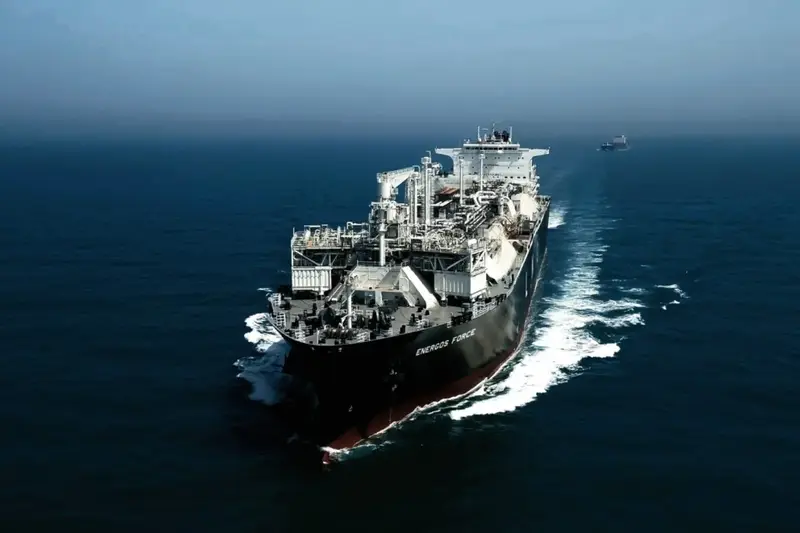
The terminal’s floating storage and regasification unit, the Energos Force, receives LNG from carrier ships, converts it back into gas on board, and sends it into the grid. The ship-based model brings storage and regasification capacity to the site without relying solely on a land-based plant. Deutsche Energy Terminal (DET), which operates the four facilities, expects Stade to feed up to 3.2 billion cubic metres of natural gas into the network in 2027. DET compares that volume with the theoretical annual heating demand of about 2.6 million four-person households.
What the new capacity adds
That household comparison helps convey the scale, but it’s an equivalence based on heating demand, not a count of homes the terminal will serve. Gas entering a shared network can go to different users and uses, including households and industry, depending on demand and how the system is operated. Actual deliveries will depend on cargo arrivals, operating conditions and demand. The 3.2 billion cubic metre figure is a forecast for 2027, not a report of gas already supplied.
This distinction matters because a nameplate or expected annual volume describes potential throughput, while supply security depends on what’s delivered and when. A terminal can provide the option to receive LNG, but cargoes still have to be procured, transported and handled. The numbers here are a statement of expected capacity in use; they don’t, by themselves, show how frequently the facility will operate or what share of national demand it will meet.
Stade completes a four-terminal floating LNG program that DET says was delivered in four years. The operator also runs two terminals in Wilhelmshaven and one in Brunsbüttel. Together, the sites give Germany additional entry points for natural gas carried by ship, alongside existing supply routes. The rapid completion says something about how quickly import infrastructure can be assembled when it becomes a priority; it says less about the long-term role each facility will play.
That range can make the system less dependent on any single supplier or transport corridor. It also gives importers more ways to respond when one route is constrained or market conditions change. The terminals broaden options; they don’t guarantee that LNG cargoes will always be available, competitively priced or delivered when needed. (And this is the part most people overlook.) Import flexibility is a tool for managing supply, not a substitute for supply itself. The effect therefore depends on how the facilities are used and how they fit with the wider gas network.
A link between immediate supply and the longer transition
DET describes the four facilities as a way to strengthen supply resilience by adding import choices. For households and businesses, the practical outcome is indirect: gas entering the network can support heating, industrial processes and other uses, while the wider system balances supply and demand. The commissioning of Stade adds capacity to that system, but the announced annual volume alone doesn’t establish what customers will pay or how much gas will be consumed. Prices and consumption reflect more than the existence of an import point.
There’s a difference between having more routes and reducing exposure to volatility. If you're working in this space, the relevant questions include whether cargoes arrive consistently, whether the grid can move gas where it’s needed, and how the site operates alongside other sources. Those are operational questions, and they’ll take actual use data to answer.
There’s also a longer-term question. LNG is natural gas in a form that can be transported by ship after cooling. Regasification makes it usable in pipelines, but it doesn’t change the fuel’s basic character as a fossil energy source. The terminal’s role in near-term supply planning therefore sits alongside the challenge of developing energy infrastructure that can support a shift toward a climate-neutral energy supply. The available information doesn’t specify how Stade will be used over time or quantify its emissions.
That tension deserves attention. Infrastructure built to address immediate supply needs can shape energy choices for years, while the pace and direction of the transition depend on wider decisions about demand, alternative energy sources and network planning. The commissioning is a material addition to gas import capacity. Its climate implications, however, can’t be assessed from the capacity figure alone. The information released doesn’t establish future utilization or the emissions associated with operation.
What to watch next
The commissioning completes a rapid buildout across four locations, according to DET, and adds Stade as another route into the gas grid. The next useful measure will be actual throughput: whether cargoes arrive and the terminal delivers gas at the scale expected for 2027. That operating record will show how much the new site contributes to import flexibility as Germany’s energy system continues to change.
Capacity is the starting point. How often the terminal is used, what role its gas plays in the network and how that role develops over time will determine the practical significance of the project. The distinction between installed capability and delivered supply is plain, but consequential. For now, Stade expands the available route map; its performance remains to be demonstrated.