AlloySelect Relaunch Adds CCS Screening Preview for CO2 Materials Choices
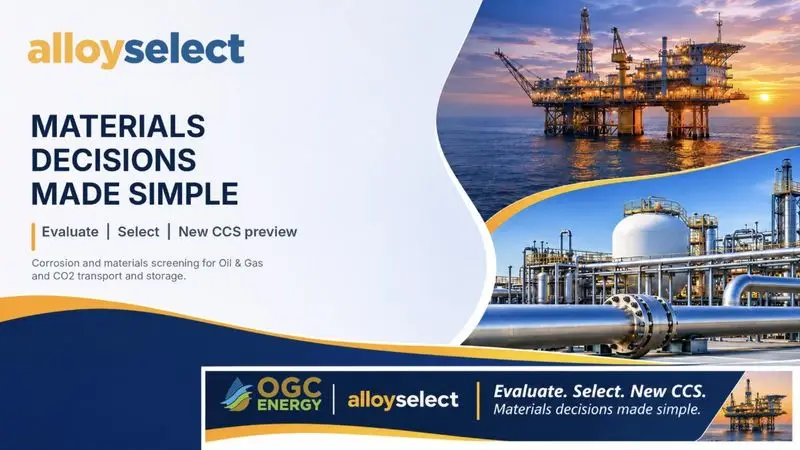
OGC Energy relaunches AlloySelect with Evaluate and Select tools and a new CCS screening preview for CO2 stream and materials decisions.

Materials choices start with the assumptions
A materials decision is only as good as the conditions behind it. Temperature, pressure, CO2 partial pressure, H2S content, water chemistry and the expected design life all feed into the corrosion estimate. Nudge one input and the corrosion allowance moves, the shortlist shrinks or grows, and the engineering effort needed to close out the decision changes with it. That sensitivity is why early-stage screening tools matter. They let a team see the dependency before it's buried in a spreadsheet nobody else can follow.
Oil and gas projects have lived with this problem for decades. Carbon capture and storage is now pulling the same questions into a new setting. The composition of a CO2 stream depends on its source, the capture process and any impurities that come along for the ride. Those impurities affect how pipelines, compression equipment and injection infrastructure behave over time. The arithmetic matters, but so does being able to explain what was assumed and why a particular screening call was made. That second part is where many early-stage discussions stall.
Eight years of field-driven development
OGC Energy first developed AlloySelect in 2018, aiming to turn its corrosion and materials engineering experience into a practical digital tool. Since then, the platform has supported clients working through corrosion assessment and materials selection. Feedback from those projects shaped the relaunch, which is aimed at a new phase of energy work where CCS and related applications sit alongside traditional hydrocarbon systems.
The stated goal is modest in scope and useful in practice: make early corrosion and materials decisions easier to explore, repeat and communicate, without removing engineering judgement from the loop. That framing matters. A screening tool that replaces the engineer's reasoning is a liability. One that makes the reasoning visible is closer to what project teams actually need.
Evaluate: putting the corrosion number in context
AlloySelect Evaluate estimates CO2 corrosion rates and shows how the selected operating conditions shift the result. Inputs and outputs sit on the same screen, including calculated pH, corrosion rate, inhibited corrosion rate, corrosion allowance and an environmental severity classification. Saved results and batch processing allow the same team to run repeated assessments across a range of cases, which is where most of the time savings show up in practice.
The practical benefit comes early in a project. A bare corrosion-rate figure invites false confidence. When an engineer can see which assumption drove the number, they can test whether it holds under a different temperature or inhibitor scenario and then carry that result into the wider discussion about materials and corrosion control. Here's the thing: the tool doesn't make the decision. It makes the decision easier to interrogate.
Select: checking a material against the actual service
AlloySelect Select tackles a closely related question: is a given material suitable for the environment it will actually see? Users specify the service conditions and a candidate material. The tool then returns a screening outcome against the relevant NACE MR0175/ISO 15156 basis, which governs materials for sour service, along with applicable notes and restrictions.
That kind of output helps teams separate a plausible option from one that needs a different material or extra scrutiny. It's most useful when project data and design assumptions are still moving, because it lets engineers flag risks while changes are cheap. Still, a screening result is not a full specification review, a procurement requirement or a project-specific qualification. Treat it as a filter that sharpens the next round of work, not as a sign-off.
The new CCS preview: start with the CO2 stream
The CCS preview is where the relaunch looks most forward. It applies the same engineering-led approach to CO2 transport and storage, starting from the stream itself rather than the pipe. Users compare a CO2 stream and its operating conditions against a chosen reference specification, review impurity limits and see where the composition deserves closer attention.
It also generates rule-based advisories on two fronts: potential acid-dropout concerns and materials screening. The company is clear that these are early warnings, not engineering approvals. The preview does not calculate full thermodynamic phase behaviour, acid-dropout quantities or corrosion rates. Those analyses remain part of project-specific engineering, which is the right division of labour for a tool at this stage.
The stated longer-term role is what could make the CCS version more than a calculator. AlloySelect CCS is intended to act as a central repository for CO2 stream specifications, industry guidance and technical data produced through Joint Industry Projects. For an area where stream specifications are still converging across capture sources and storage sites, a shared reference point could help teams make more consistent materials calls. Whether that repository gains traction will depend on how much of that JIP data becomes available and how it's maintained as the preview matures.
And yet the usual caveat applies. Impurity tolerances in CCS are an active area of technical work, and a screening tool is only as current as the specifications behind it. Engineers should check which reference basis the preview uses against their own project's stream definition before relying on any advisory.
Where to see it in Amsterdam
OGC Energy will demonstrate AlloySelect Evaluate and Select, along with the portable CCS screening preview, at the Offshore Energy Exhibition & Conference on 24-25 November 2026 at RAI Amsterdam. Visitors can find the team at stand 2.200, work through representative conditions and talk through how the tools might fit their own projects. The relaunch will also be introduced on the exhibition's Stage programme on Wednesday, 25 November.
For details on the platform or to arrange a demonstration, visit alloyselect.com.
Watch the CCS preview closely over the next year. If the stream-specification repository fills out with real JIP data, it could become a useful shared reference for a part of the transition where engineering consistency has lagged behind ambition.