Gothenburg Port’s 500-Tonne Biogas Facility Targets 2027 Shipping Fuel Supply
A new liquefaction plant is planned to supply 250 GWh of liquefied biogas a year to ships, heavy transport and industry from 2027.
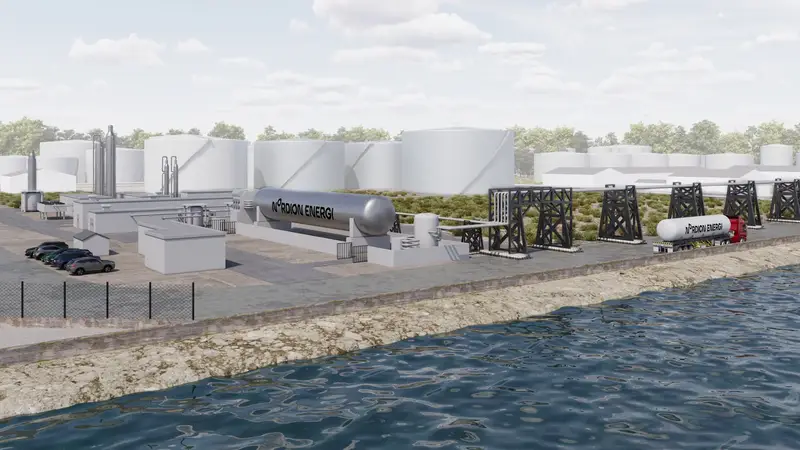
A 500-cubic-metre storage tank has been installed at the Port of Gothenburg, marking a major construction step toward a liquefied biogas facility planned to open in the second quarter of 2027. Once operating, the plant is expected to produce 250 gigawatt-hours of liquefied biogas (LBG) annually, creating a new route from the west Swedish gas grid to fuel users including shipping, heavy transport and industry.

The project’s significance lies in connecting gas-grid supply with liquefaction and delivery at a major port. Nordion Energi is building and will own the facility. Its direct connection to the gas grid is intended to give Swedish biogas producers with grid access a way to sell gas into the LBG market, while making the liquefied fuel available to vessels and other customers that can use it.
Storage installed as construction advances
The tank is the first of the plant’s main components to be put in place. It arrived by vessel and weighs close to 140 tonnes. Its 500-cubic-metre volume will allow it to store up to 200 tonnes of LBG when the facility is operational. Groundworks, including foundations and base slabs, have already been completed.
Those details show the scale of the planned storage and the progress made so far, but they do not establish the plant’s eventual output or customer demand. The 250 GWh annual capacity is a design figure for the facility; actual production and use will depend on the plant becoming operational and on fuel being supplied and taken up by customers.
The port describes LBG as a renewable fuel with low climate impact that can replace fossil alternatives in several sectors. For shipping, the immediate practical question is whether production, storage and bunkering can be coordinated to serve vessels that are designed to run on the fuel. The facility is intended to increase the scale at which the port can offer LBG for bunkering.
A potential link between producers and vessel operators
The port says vessels that use LBG are already calling there regularly, while producers are also present. ST1 Biokraft has signed an agreement securing part of the planned plant’s capacity. The announcement does not specify the share reserved, the total number of customers, or how much of the plant’s output has been contracted.
That existing activity provides a starting point for the new supply chain. Grid-connected producers could deliver biogas into the network; the plant would then liquefy it for storage and use. Ships can take on LBG at the port, while heavy transport and industrial users are also identified as potential customers. The arrangement may give producers another route to market and give users a local supply point, but its reach will depend on how much fuel is produced and how demand develops.
The port links its expectations for greater bunkering to the number of vessels on order for LBG operation. That signals a possible increase in demand, though no vessel count or projected fuel volumes are given. Nor does the project information quantify the emissions reductions that using LBG could deliver. The climate benefit will depend on the fuel’s production and use compared with the fossil fuel it replaces.
Capacity and the next milestone
The stated annual capacity of 250 GWh is described as equivalent to the consumption of 500 trucks or the bunkering of 50 vessels. These comparisons illustrate the intended scale, but they don’t say how output would be divided among shipping, trucking and industry. A facility supplying several types of customer will need dependable production and a workable schedule for storage and deliveries.
For the port, the tank installation moves the project from completed groundwork to visible construction of its operating infrastructure. The next major marker is the planned opening in the second quarter of 2027. Progress toward that date, along with how much capacity is committed and how customers use the available fuel, will indicate whether the plant can turn its planned output into a larger role for LBG in regional shipping and transport.