SolarEdge Duo Optimizer Cuts Component Count for Commercial Solar
The U.S.-made optimizer connects two modules while keeping independent tracking, adding connector monitoring and distributed arc detection.

SolarEdge’s Duo Power Optimizer targets a practical constraint in commercial and industrial solar: reducing installation work and component count while retaining independent power tracking for each panel. One unit connects two modules, cutting optimizer numbers by 50% compared with one-to-one designs, the company says.

Announced November 16 ahead of RE+ 2026 in Las Vegas, the product combines module-level energy harvesting and monitoring with a 2:1 connection design. Each connected module has its own maximum power point tracker (MPPT), so the pair does not share a single tracking point. That distinction matters when modules receive different amounts of sunlight or produce at different levels.
Fewer units, independent module tracking
In a conventional string inverter arrangement, the electrical behavior of panels connected in a string can affect the string’s output when one panel underperforms. Module-level optimization addresses that limitation by allowing each panel to operate independently. Shading, degradation or differences in panel performance can then have less effect on the output of neighboring modules.
The Duo keeps that per-module tracking while requiring fewer optimizer units across an array. For developers, engineering, procurement and construction (EPC) firms, and installers, fewer units can mean less equipment to handle and attach, along with fewer connections to make. SolarEdge positions the design as a way to reduce balance-of-system needs and installation labor without giving up module-level optimization.
The scale of any labor or cost effect will depend on project design and installation conditions. Cutting optimizer count in half does not, by itself, establish a particular reduction in project cost or construction time. The more immediate change is at the equipment level: two modules connect to each optimizer, with separate tracking retained for each.
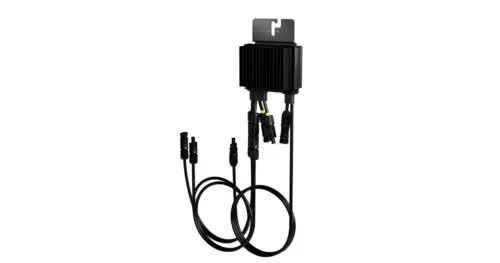
SolarEdge’s U.S.-made Duo Power Optimizer connects two solar modules while maintaining independent module-level power tracking for commercial and industrial solar installations. Credit: SolarEdge
Wiring and array layouts
The optimizer has two pairs of input leads. One is shorter, for the nearer module; the other arrives pre-extended for the adjacent module. SolarEdge says this arrangement reduces surplus wiring and removes the need for installers to make jumpers in the field. Fewer improvised connections can simplify work across a large array, where repeated small tasks add up.
The design also supports modules installed in different orientations. That makes it relevant to east-west layouts and dual-tilt racking, where panels may face different directions or sit at different angles. Independent tracking is useful in those configurations because the modules may not receive sunlight in the same way at the same time.
For project teams, the fit will depend on whether a site’s module arrangement, wiring plan and equipment choices match the optimizer’s connection design. The product’s two-module format changes how the optimizer count maps to the array, while the separate MPPTs preserve module-level operation.
Connector monitoring and arc detection
Safety features are another part of the launch. SolarEdge says the Duo extends its Sense Connect technology to input and output connectors, where it monitors temperature. The aim is to flag developing connector problems before they progress to overheating or electrical arcs.
The company also describes each optimizer as an individual arc sensor. That distributes detection across the array, rather than relying only on monitoring at the inverter. SolarEdge says the system covers strings with up to 3,280 feet of total cable between the inverter and optimizer, and can help narrow a fault’s location to the optimizer area.
Locating a problem nearer to where it develops may help technicians troubleshoot and maintain a system. The company’s description does not provide performance figures for detection rates or field results, so the practical value of the feature will depend on how it performs in deployed systems and how maintenance teams use its fault information.
U.S. manufacturing and project fit
The Duo is manufactured at SolarEdge’s Florida facility. The company says it is designed to meet U.S. Domestic Content and Foreign Entity of Concern (FEOC) requirements, and that its domestic-content eligibility levels align with those of its earlier U.S.-manufactured optimizers. Eligibility remains subject to applicable tax guidance and the details of an individual project.
SolarEdge plans to show the Duo at RE+ 2026. For commercial solar teams, the product’s main proposition is a combination of fewer optimizer units, independent tracking for two modules, revised lead lengths and added connector and arc monitoring. The next useful measure will be how those design choices translate into installation effort and maintenance experience across real project layouts.