Top Rack Technology Unveils Six Rooftop Solar Mounting Products at RE+ 2026
New brackets, waterproofing and rail adjustments target faster rooftop solar installation, with a digital tool linking project design to materials.

Top Rack Technology’s six mounting products at RE+ 2026 focus on the work that can shape a residential solar project’s cost and pace: attaching equipment to varied roofs, sealing penetrations and connecting rails. The lineup includes adjustable hardware, a pre-applied waterproofing component and a system designed to conceal array edges. The company is also presenting an online tool for project layouts and bills of materials.

For installers, these features address separate steps in rooftop work. Attachment hardware must fit the roof conditions and array design; penetrations need to be sealed; and rails and modules need to align. A product that reduces adjustments or manual steps could help crews keep projects moving, though the practical benefit will depend on roof type, installation details and how the equipment performs in the field.
Attachments and roof sealing
The TRT-G2 Bracket is designed around practical installation requirements and competitive pricing. It can be paired with ButyLok, a shoe-like component containing pre-applied, gel-like butyl material. When the bracket compresses the component, the butyl spreads across the sealing surface. That arrangement is intended to reduce the need for installers to apply sealant manually at the attachment point.
Rooftop solar attachments require care because they involve roof penetrations. Bringing the bracket and sealing component together as a coordinated installation may simplify that step, but the source provides no performance figures or independent test results for the assembly. Installers will still need to follow the product’s installation requirements and account for the roof materials and conditions at each project.
Another residential attachment in the lineup is SAVRIX. Top Rack Technology describes it as developed with manufacturing efficiency, installation practicality and cost competitiveness in mind. The available product information does not provide further design details, so its specific field advantages and fit across different roof types remain unclear.
The RF-2 Rail Fastener targets the connection between the mounting bracket and rail. Simplifying that connection can matter across a project because crews repeat the task at multiple attachment points. The company has not supplied timing or labor data to quantify any savings, but the fastener’s stated purpose is to make rail-to-bracket assembly easier.
Adjusting to roof conditions
FreePivot is the lineup’s most visibly adjustable bracket. Its rail fastener rotates through 360 degrees, allowing the rail connection to accommodate attachment points that do not line up perfectly. Built-in height adjustment is intended to help installers account for uneven roof surfaces. The bracket uses all-metal construction, and its one-orientation design and single-socket installation concept are meant to limit repositioning and tool changes.
That combination addresses a common practical challenge in rooftop work: the mounting layout has to meet the roof as it is, rather than an idealized flat plane. Adjustability can give installers more room to align rails and manage height differences. The extent of that advantage will depend on the roof and system design, and no adjustment range or installation-time comparison is provided.
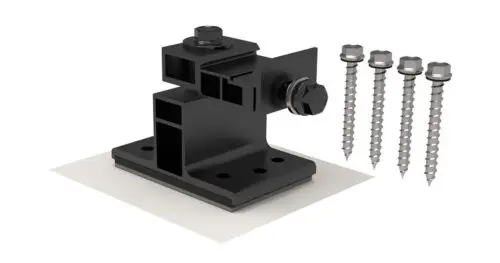
Top Rack Technology’s FreePivot Bracket has a rotatable rail fastener and built-in height adjustment. Credit: Top Rack Technology
The Full-Coverage Skirt System addresses appearance rather than attachment or assembly. It conceals exposed array edges to give a residential installation a more finished look. That can help solar equipment fit the visual expectations of a property, though the product information does not specify its dimensions, compatible systems or effect on installation steps.
Planning before crews arrive
Alongside the new hardware, Top Rack Technology is showing its existing TRT 01 Rail-less Base System, TRT 02 Rail-Base System and TRT 03 Tile Hook System. The range spans different mounting approaches, while the new products focus on individual installation tasks such as sealing, rail connection and adjustment.
The company’s Online BOM Design Tool connects early project planning with material selection. Its functions include project setup, structural design inputs, module layouts, engineering verification and automated bill-of-materials generation. For installers and distributors, a tool that carries layout information into a materials list may help coordinate design and procurement before work begins. Its usefulness will depend on the accuracy of project inputs and how well the resulting list matches site conditions.
Mounting hardware rarely determines a solar project’s value on its own, but repeated installation steps can affect crew time and project coordination. Top Rack Technology’s new products are aimed at those practical details: fewer manual sealing steps, more options for aligning rails, and a cleaner array edge. The next useful evidence will come from field experience across different roof types, including how quickly crews can install the systems and how reliably the attachments and seals perform over time.