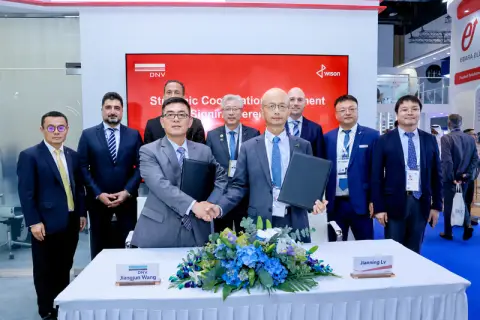
NeoVolta’s Georgia Battery Factory Targets 4 GWh of Storage Production
NeoVolta’s new Georgia plant starts with a 4-GWh line, combining battery cells with in-house monitoring and energy management systems.

NeoVolta’s new battery storage plant in Pendergrass, Georgia, marks a shift from selling home systems to manufacturing equipment for residential, commercial, industrial and utility-scale projects. The facility’s first production line is designed to reach 4 GWh a year, with a second line planned to bring capacity to 8 GWh as orders support expansion.

NeoVolta Power, a joint venture between NeoVolta and PotisEdge, opened the roughly 210,000-square-foot site in September. Located along the I-85 corridor northeast of Atlanta, the plant is intended to supply U.S. project developers with storage systems designed to meet domestic-content requirements. Its scale puts the company in a broader manufacturing shift that is expected to unfold in stages, as cell production and other parts of the supply chain develop.
From home batteries to factory production
NeoVolta began in 2018 as a residential storage company founded by Brent Willson in La Jolla, California. Its first battery system shipped in 2019, and the company listed on Nasdaq in 2022. For several years, it sold home systems such as the NV14 through certified solar installers.
CEO Ardes Johnson said a sharp contraction in the residential storage market, following changes to federal incentives, made the case for a wider business. NeoVolta moved toward serving multiple customer segments and building its own manufacturing capacity. The Pendergrass plant is the largest step in that transition, taking the company from residential equipment sales to a production platform measured in gigawatt-hours.
Controls are a central part of the product
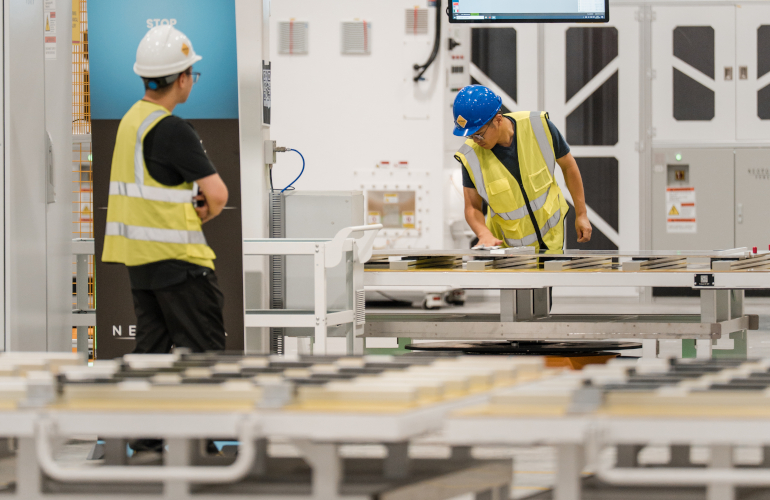
NeoVolta Power manufacturing in Georgia
The factory’s role extends beyond putting cells into enclosures. NeoVolta Power says it designs and builds its own battery management system (BMS), energy management system (EMS) and intelligent cell contact system (iCCS), then integrates them with cells into packs and containers. The equipment is built and tested on the company’s production line.
The iCCS sits on the battery pack and uses voltage and temperature sensors on each cell. Johnson said it can flag a failing cell minutes before it becomes a safety event, confirm a thermal event in about a minute to trigger suppression, and track degradation months ahead. He described its design as easier to automate and less costly than the wire harnesses still common in the industry.
The BMS monitors cells and packs, balances cells actively and provides protection, drawing on experience with electric-vehicle battery management. The EMS manages how storage interacts with the grid, including services such as frequency regulation and energy arbitrage. Together, those systems can make a battery installation an active grid resource rather than a unit that simply stores electricity.
This level of integration matters because some storage products treat the direct-current block largely as a container for cells and basic monitoring. NeoVolta’s approach puts monitoring, management and grid-facing controls into the block itself. Johnson said the company’s NVAPEx platform reflects that design, with cell-level safety monitoring and active system management built into the product.
Scaling production brings supply and staffing challenges
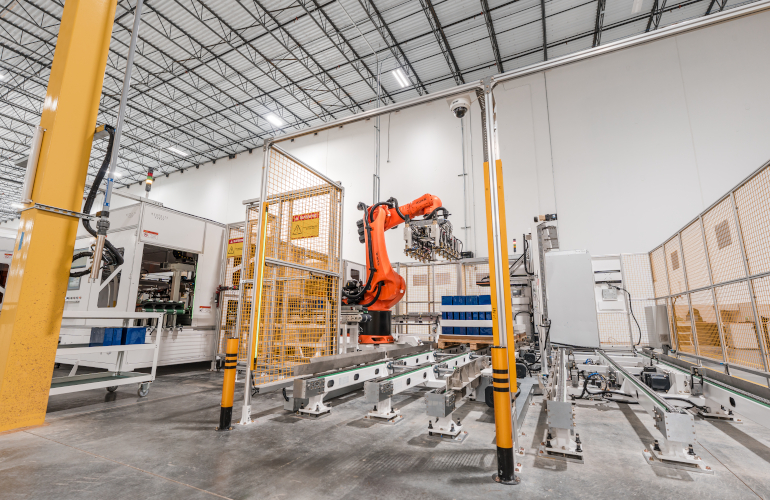
NeoVolta Power manufacturing in Georgia
NeoVolta had experience in residential storage but not at factory scale. The joint venture gave it access to PotisEdge’s expertise in installing equipment, commissioning production lines and increasing output. Johnson said the plant is highly automated, while the company continues to hire engineers and staff for facilities and operations.
Cell supply is another constraint. Johnson said U.S.-made cells aren’t yet readily available at the volume or price needed, so imported cells are filling the gap as domestic capacity develops. NeoVolta expects supply to shift over time from China toward Southeast Asia and, eventually, to U.S. production. Its agreement with SK On covers 9 GWh of U.S.-made lithium iron phosphate (LFP) cells from 2027 through 2031, with a framework that could expand to 18 GWh. Details of that agreement are available in the announcement about NeoVolta’s planned SK On cell supply.
Starting production also requires commissioning the line, training workers and converting prospective demand into binding contracts. Johnson described the initial ramp as a financial and operational undertaking supported by equity, debt and project-level financing, while the company’s residential business was contracting.
Product plans extend toward utility scale
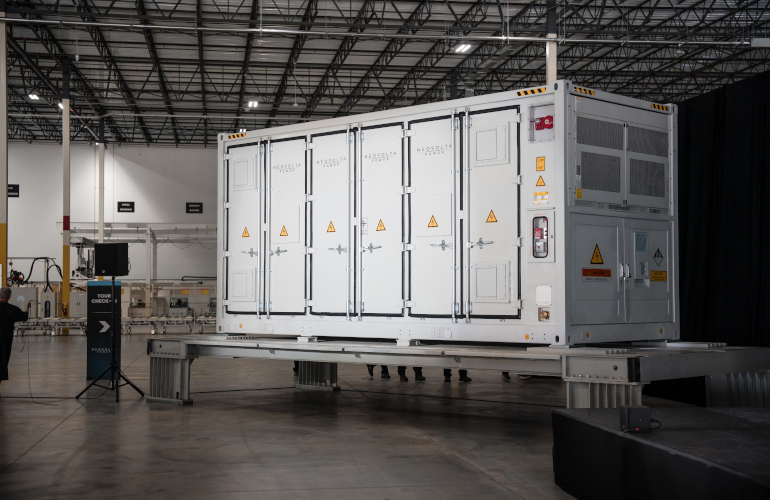
NeoVolta
NeoVolta’s commercial and industrial product, NVGAIN, pairs the BMS, EMS and iCCS with an integrated power conversion system (PCS). Johnson said the company plans to carry that power electronics capability into a PCS-equipped version of its utility-scale platform. The goal is to extend the integrated design already used in NVGAIN to larger grid-connected systems.
For the next three to five years, Johnson expects the pace of U.S. battery manufacturing to depend in part on how quickly supply chains localize. The company is also seeing demand from grid modernization, utility-scale storage and rising data-center power needs. The practical test for manufacturers will be whether they can combine capable controls and power electronics with a dependable path to domestic cell supply. For NeoVolta, the Georgia plant is where that transition moves from plans to production.